
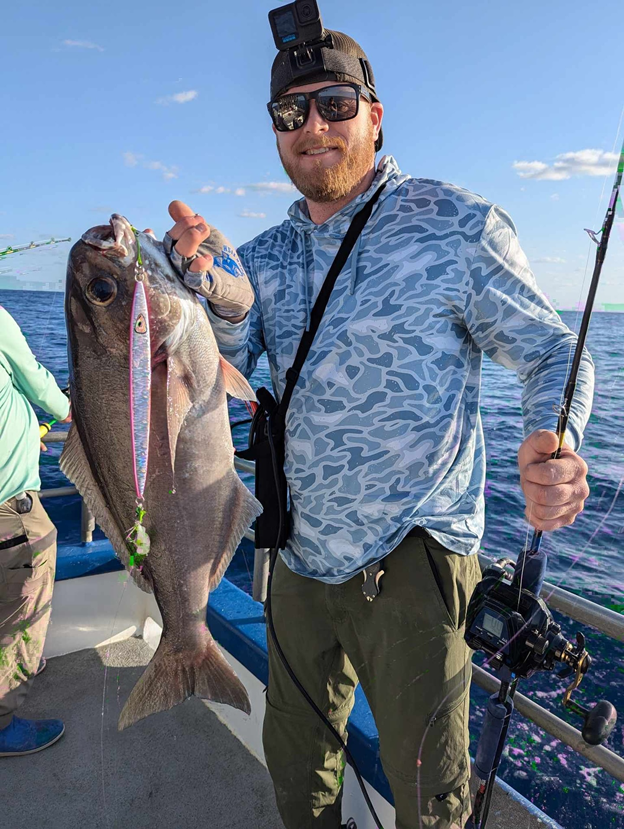
In addition to vital fishing tools like fish grippers and split ring pliers, there are some other fishing essentials, such as certain terminal tackle, that you should also have on board. Here are among the most basic and important. Never leave port without these!
Split Rings
Split ring pliers (which are among our list of the most essential fishing tools) won’t do you much good if you don’t have spare split rings to make them useful in the first place.
Let’s just posit a quick hypothetical. Suppose you’re out there and one of your hooks gets straightened out, or it’s too dull to really bring back with your hone.
Good news, you have spare trebles. Bad news, you don’t have any spare split rings. How are you going to attach the new hooks?
In some instances, you might be able to just recycle the split rings that are already on the lure, but there are times in which split rings in poor condition should be replaced along with the hooks you’re retiring.
Either way, you should always keep at least a few spare split rings in your tackle bag. It’s better to have them and not need them than need them and not have them. And don’t forget the split ring pliers, either!
Trebles and Assist Hooks
This follows right on the heels of the split rings. While spare split rings are important, hooks are even more important. Any lure, slow pitch jig or otherwise, isn’t much use if it isn’t tipped with a hook.
And, as you know, there are times when replacing hooks becomes imperative. Sometimes you can wait till you get back to port, but other times, when you’re on the water and the fish are biting, waiting to make repairs till you pull into the slip is far from expedient.
The point is, you should always be prepared with some spare hooks, not just trebles but single hooks, and not just in one size. You’ll want spares in all sizes that are appropriate for what you’re fishing.
Take our word for it - you don’t want to get on the water, discover the pattern that fish are hitting, and then realize you need to replace hooks on those lures. Just make sure you’re ready with replacements, and get high-quality replacements, like Mustad hooks or Gamakatsu hooks.
Spare Mono
You might fish with braid and fluoro as your leader. That is still no excuse not to take along some spare mono in a relatively heavy pound-test, just to have on board.
Should your leader fail, you’ll be ready with a quick fix. And, worse case scenario, should you need to re-spool on the boat, at least you won’t be up a creek without a paddle.
Really, though, the purpose is to have a hedge against an abraded leader. Then all you need besides the line is the knowledge of how to tie an albright knot, or better, a uni-to-uni, and you’ll be able to replace your leader on the water, with no worries.
Having some spare mono on board can also make it possible for you to rig your jigs with stinger hooks, if you notice you’re getting a lot of short strikes, but can’t connect.
Also, if you’re fishing bait, and have brought along a bunch of pre-tied snells, spare mono is even more valuable. Suppose you should lose all those snells on snags? With mono and the knowledge of how to tie your own snells, you can rig your own on the water if you run out, assuming you brought spare hooks (which should go without saying).
Swivels (Various Sorts)
Not every rig is going to need swivels, but there are some instances in which you might be happy you had them in your bag.
One is at the end of your leader. If you’re searching and haven’t dialed in on what the fish are hitting, tipping your terminal tackle with a snap swivel will make it easier for you to switch between lures easily, without needing to re-tie every time. It’ll also save your leader, and it can diminish line twist.
That’s another thing - swivels will inherently cut back on line twist, which can be huge when slow pitch jigging.
The other thing about using a swivel as the interface between your leader and main line, on top of the fact that it reduces twist, is that it will save your spool. If you tie your leader directly onto your braid, while that interface will be stronger than if you had used a swivel, you will need to sacrifice a little of your braid every time you tie on. Just something to think about.
Reel Oil and Grease

Let’s just be direct: you won’t be able to totally disassemble and maintain a reel on the water, at least during most routine trips. But the truth is that this is no excuse not to be ready with some essentials.
Chiefly, you should have some reel oil and grease on board, because much of the time it isn’t even necessary to take the reel part. Often, a drop or two of grease on the lineroller, or on the reel handle, is all you’ll need.
And it’s much better, again, to have some oil and grease on hand and not need it than the other way away.
Spare Jigs
That we have to spell this out is beyond us, but why there are some anglers that will buy single lures or jigs just makes no sense to us. A single bad drop or cast over structure, and you’re out. If it’s worth buying one, it’s worth buying five, or more.
All we can say is, one is none and two is one. If you’re going to buy one jig, buy a few spares. They are way too easy to lose.
Stock Up on Fishing Essentials and Tools Here
If your tackle bag is missing any of these fishing essentials, make sure you stock up before you head out on the water again - and check out recent post on vital fishing tools and make sure you’re prepared with them as well.