
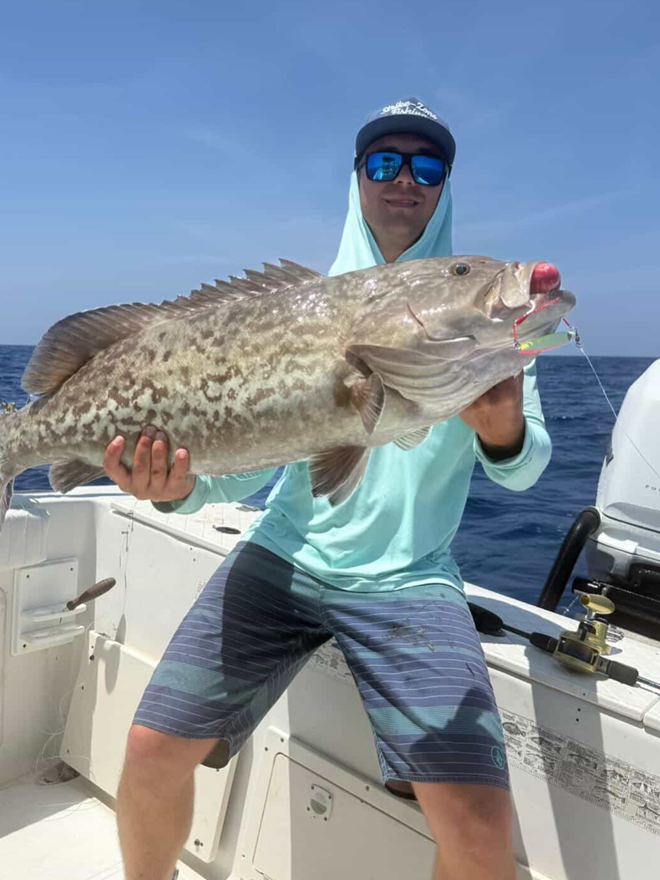
Whether you’re fishing for strawberry grouper, red grouper, or gag grouper, slow pitch jigging can be a highly effective technique.
That is, if you can find the fish, and if you know how to work the grouper jig. While grouper are powerful predators, they largely rely on ambush tactics and will hug structure very closely. That makes presentation critical to success.
All the same, if you know what you are doing you can clean up while slow pitch jigging for grouper. Start with this guide.
Find the Grouper
Most important is that you find the fish. You can drop a rig a thousand times in a day and come up with nothing if there are no fish there.
So, how do you find grouper? That largely depends on species, but here are some high level notes:
- You will rarely if ever find grouper over open sand flats, even at the right depth. If the bottom is flat and featureless, avoid it.
- Look for rocks, reefs, and wrecks. Grouper will congregate in these areas magnetically.
- Depth matters; it’s possible to find grouper in shallow water, especially when they are young, but for the most part you will find them before 90 and 300 feet. Structure in these depths will hold grouper.
Young grouper and gag grouper will occasionally be in water at depths less than 90 feet, but that’s generally where you’ll want to be targeting them.
If you have a fish finder, you can also check the structure to see if there’s a lot of bait hanging out around it. If there is, there’s an even better chance that there will be predators nearby.
Select a Slow Pitch Jig (and Tackle)
Grouper are not necessarily picky, and will strike jigs of a whole bunch of different colors and patterns, so what’s most important here are the size and weight of the slow pitch jig.
Generally speaking, you’ll want one gram of jig weight for each foot of water. So, if you are jigging in 100 feet of water, you want a jig that weighs 100 grams. If there is a strong current or you are using very heavy line that creates a lot of drag in the water, you may need a little extra weight.
The reason for this is that you want a jig that will stay vertical as you work it. It’s possible to catch fish with a sloppy presentation, but if you want faithful action from the jig, you want it to remain as vertical in the water column as possible.
In clear water, bright colors, like white, chartreuse, pink, and other “glow” colors can be highly effective if only for the fact that they get the attention of predatory fish. In stained water conditions, darker colors can be effective as well. Glow and UV-reflective jigs can also be highly effective in deeper water where light struggles to penetrate.
As for tackle, while you can catch grouper on spinning tackle, conventional tackle is more robust and reliable. This is one area in which you will want heavier braid, too, since while it is true that grouper aren’t particularly long-lasting fighters, that initial run to cover will require a lot from you to put the brakes on them.
Working the Jig
One of the great things that makes slow pitch jigging effective for grouper is that it has a slower, more rhythmic, more entrancing cadence compared to speed jigging. While you can catch grouper while speed jigging, the hypnotic motion of slow pitch jigs is often more enticing, keeps your jig in the strike zone for longer, and can entice skittish fish to bite, which might otherwise snub a jig that’s worked too fast.
Basic notes are as follows: drop your slow pitch jig down to the bottom. Let it sit there for a second. Believe it or not, if you catch the attention of a grouper in the vicinity, the fish will sometimes pick it right up off the bottom. Keep your line under a little tension here, so you’ll be able to feel a strike.
If you don’t get a taker on that initial drop, give your reel handle a half a crank and raise the rod tip slowly, before letting the jig fall. Let the line go only slightly slack as it drops as most strikes will come on the drop and you want to be able to feel it.
Bounce the rod tip a few more times before you give the reel another half crank to raise the jig further. What you want to impart to the jig here is a rhythmic, irregular, slow, darting cadence that drives predatory gamefish, in this case grouper, wild.

Explore Slow Pitch Jigs (Including Grouper Jigs) Here
Hopefully you found this high-level overview for slow pitch jigging for grouper to be helpful. Use it as a jumping off point, check out our collection of slow pitch jigs and other saltwater jigs, many of which can be effective as grouper jigs, and stock up before you take your next trip out in search of these good-eating gamefish.